How wide should a garden path be?
For a main garden path, 90–120 cm (3–4 ft) is the comfortable range. Go down to 60 cm (2 ft) only for side paths and stepping stones, and up to 150 cm (5 ft) where two people should walk side by side.
| Path | Width |
|---|---|
| Stepping stones, access paths behind beds | 45–60 cm (18 in–2 ft) |
| Side path, one person | 60–90 cm (2–3 ft) |
| Main path, one person with a wheelbarrow | 90–120 cm (3–4 ft) |
| Two people side by side | 120–150 cm (4–5 ft) |
| Front door path | 120 cm (4 ft) or more |
| Wheelchair, with room to pass or turn | at least 90 cm (3 ft), 150 cm (5 ft) to pass |
| Single-car driveway | 3–3.7 m (10–12 ft) |
Why wider than you think
Plants grow over path edges. A path that looks fine at 80 cm on a plan often ends up at 50 cm by midsummer once lavender or grasses spill onto it. If the path runs between borders, add 15–20 cm on each side, or choose plants that stay upright.
Match the width to the job
- A wheelbarrow is about 60–70 cm wide at the handles, so anything under 90 cm is tight.
- A ride-on mower, a cart or a garden tractor needs 120 cm or more, and wider at corners.
- Paths to the bins should fit the bin plus your hands: at least 90 cm.
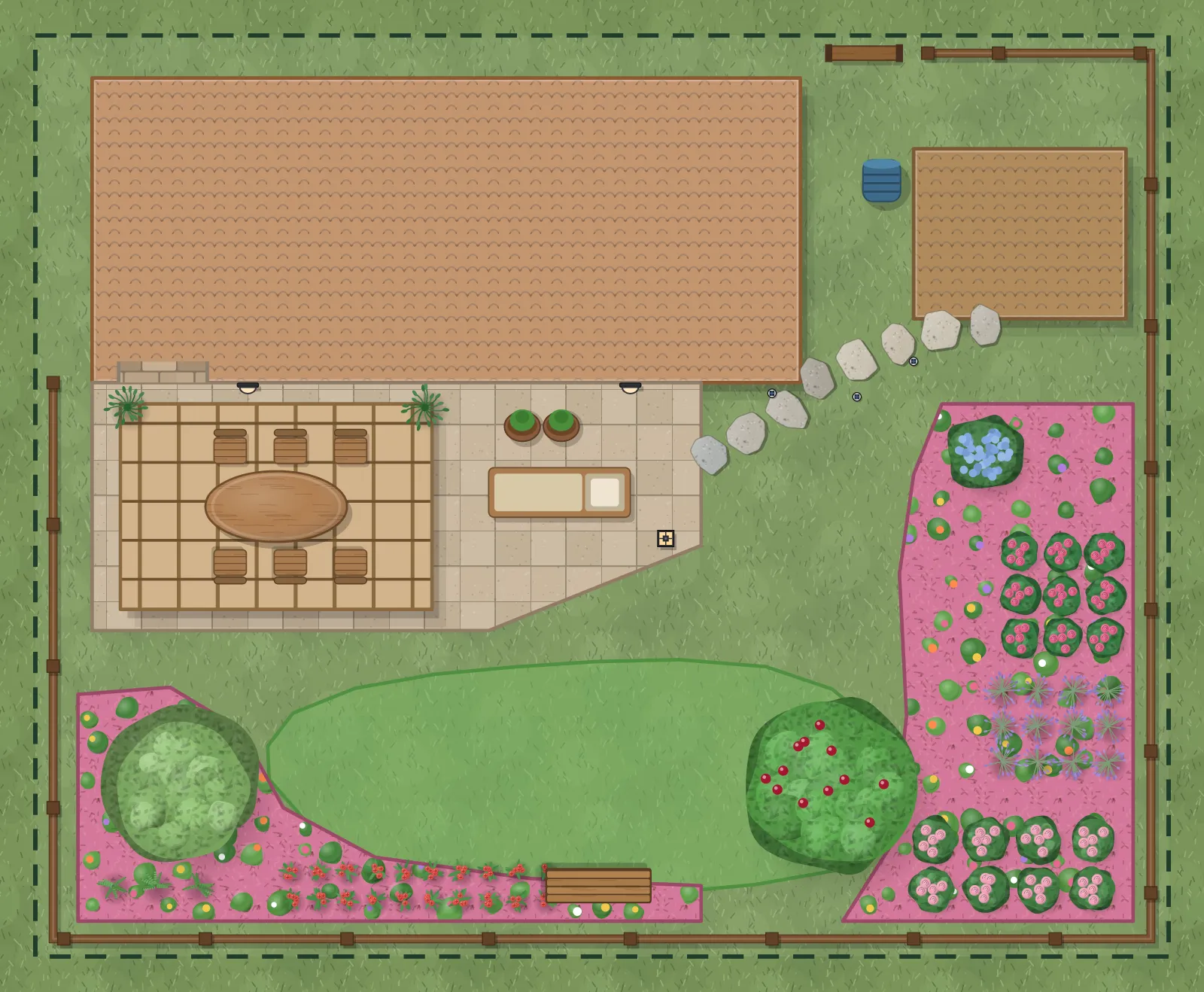
- Stepping stones work best spaced at a normal stride, about 60–65 cm (24–26 in) centre to centre.
Proportion matters too
In a large garden a narrow path looks mean, and in a small one a wide path eats the space. A useful rule: the main path should be wide enough for its job and roughly in proportion to the house front it leads to. Curves look generous only if they are gentle; tight wiggles just get cut across.
Materials and width
Gravel needs an edge to stay put and is easiest in straight runs. Pavers and slabs come in fixed sizes, so choose a width that is a whole number of slabs to avoid cutting. Stepping stones set in lawn suit paths you use a few times a week; anything used daily deserves a continuous surface.
Planning a whole yard? Start with how to plan a backyard layout.